
Search
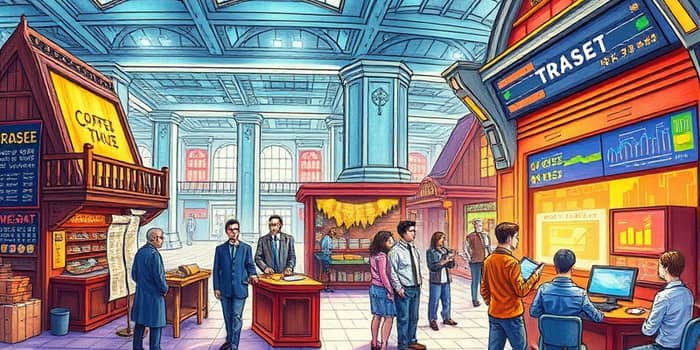
The journey of stock exchanges is a powerful story of human ingenuity, evolving from secretive gatherings to dynamic global networks.
From coffeehouses to cloud servers, this transformation has reshaped how we invest, trade, and build wealth.
Understanding this history not only inspires but also provides practical insights for navigating today's complex markets.
Exchanges began as informal hubs where merchants traded commodities and debt.
In 1611, Amsterdam saw the first modern stock trading with the Dutch East India Company.
This marked the birth of publicly traded companies, laying the groundwork for future systems.
The Buttonwood Agreement, signed May 17, 1792, was a pivotal moment.
It established rules and commissions to foster public confidence in U.S. markets.
By 1817, the New York Stock & Exchange Board formalized these practices with a constitution.
Early exchanges required strict dress codes and membership fees, reflecting their exclusive nature.
Key milestones from this era include:
These steps gradually opened doors for broader participation over time.
Market structures evolved dramatically from call markets to continuous trading.
In the 1870s, specialists emerged to manage limit order books on the trading floor.
This shift allowed for simultaneous trading in all stocks, increasing efficiency.
The late 20th and early 21st centuries brought electronic innovations.
NASDAQ started in 1971 as the world's first electronic stock market.
It introduced over 2,500 securities, revolutionizing access and speed.
Major modern changes include:
These advancements have made markets more fluid and responsive to global demands.
Today's exchanges are characterized by staggering volumes and values.
The NYSE reports an average daily trading volume of approximately 1.54 billion shares.
This is valued at around $80.6 billion, highlighting immense liquidity.
Nasdaq often surpasses 9 billion shares daily, driven by tech giants.
Overall equity average daily volume reaches 15.9 billion shares monthly.
Options trading averages 57.0 million contracts, showing diverse investment strategies.
Market capitalization is projected to hit $60.4 trillion by 2026.
Indices like the S&P 500 and Dow continue to break records.
For instance, the US500 index hit 6,923 points in early 2026.
This represents an 18.80% year-over-year increase, signaling robust growth.
Most traded stocks in October 2025 included leaders from both exchanges.
These figures underscore the dominance of technology and innovation sectors.
Sector performance drives market dynamics and investor opportunities.
Information technology holds a 36.12% weighting in the S&P 500.
It is fueled by AI, cloud computing, and semiconductor advancements.
Other sectors contribute uniquely to trading volume and stability.
The table below summarizes key sectors, their growth drivers, and trading impacts:
Recent data shows financials up 2.9% monthly, while utilities declined.
Understanding these trends helps investors align strategies with sector cycles.
Technological advancements have shattered barriers to entry.
Online trading platforms and user-friendly mobile apps are key enablers.
They have made stock trading accessible to retail investors worldwide.
Improved financial literacy has further popularized participation in markets.
Exchange-traded funds (ETFs), like SPDRs launched in 1995, play a crucial role.
They allow smaller investors to gain exposure to high-value stocks.
This boosts overall market liquidity and diversifies portfolios effectively.
Key steps for new investors to get started include:
These practices foster confidence and long-term success in evolving markets.
Market participants exhibit distinct behaviors that influence trading patterns.
Institutional investors often gravitate toward NYSE-listed companies for stability.
Nasdaq stocks typically attract high-frequency traders and retail speculators.
This divergence reflects the unique roles each exchange plays.
To thrive, investors should balance these perspectives in their approach.
Common pitfalls to avoid include:
By learning from history and leveraging modern tools, anyone can participate meaningfully.
The evolution of exchanges is a testament to progress and inclusivity.
From the Buttonwood Agreement to digital platforms, markets have become more transparent.
Embrace this journey to build a resilient and informed investment strategy.
References